
Call Us
For International Orders
+91 90731 04777Toll Free
+91 90731 04777 Monday to Saturday10:00 AM - 6:00 PM
Industries
About Us
Terms & Conditions
© 2026 Statrootindia Private Limited. All Rights Reserved.
For International Orders
+91 90731 04777Toll Free
+91 90731 04777 Monday to Saturday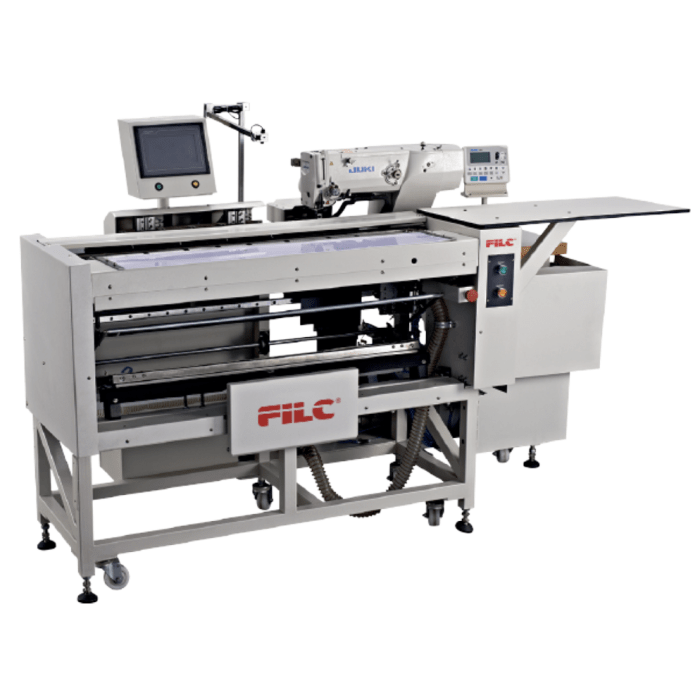
₹0.00
The FILC FCK 7000 is a high-speed automatic buttonhole indexing system designed for men’s and ladies’ garments, delivering precise buttonhole positioning, overlapping feeding efficiency, and high productivity with minimal operator skill requirements.

For detailed product information click here
The FILC FCK 7000 Automatic Button Hole Indexer is an advanced automated sewing unit developed to streamline and optimize buttonhole production for shirt manufacturing. Designed for both men’s and ladies’ wear, the system combines precision indexing technology with high-speed sewing performance to deliver consistent buttonhole quality and significantly improved production efficiency.
The machine features an automatic overlapping feeding system, allowing operators to position the next garment while the current garment is still being processed. This intelligent workflow reduces operation time by approximately 5 seconds per garment, increasing overall productivity and minimizing machine idle time.
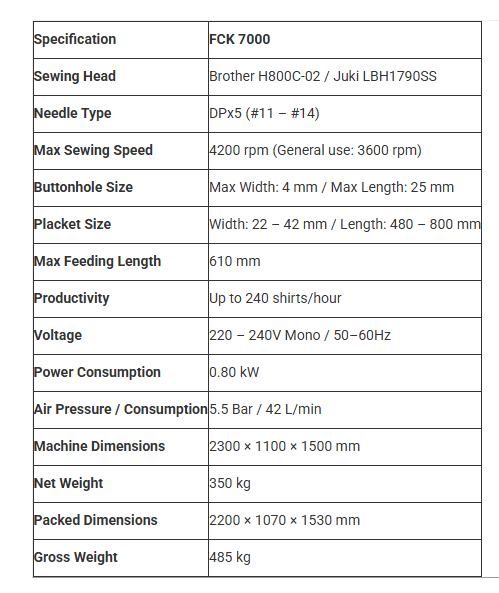
The FCK 7000 supports both right feeding for men’s garments and left feeding for ladies’ garments, offering flexible production capability for different apparel categories. It can sew 1 to 20 buttonholes and store up to 999 programmable patterns in memory for rapid style changes and repeat production.
To ensure accurate positioning and material handling, the machine is equipped with:
The machine utilizes premium components including Panasonic X-drive motors and SMC pneumatic systems, ensuring stable operation, long service life, and precise motion control. The integrated I/O diagnostic page also simplifies maintenance and sensor positioning for operators and technicians.
With productivity of up to 240 shirts per hour, the FCK 7000 enables one operator to efficiently manage multiple machines, drastically improving production output while reducing labor dependency and skill requirements.
For International Orders
+91 90 7310 4777Toll Free
+91 6293 000 063 Monday to Saturday Creating an account has many benefits: check out faster, keep more than one address, track orders and more.